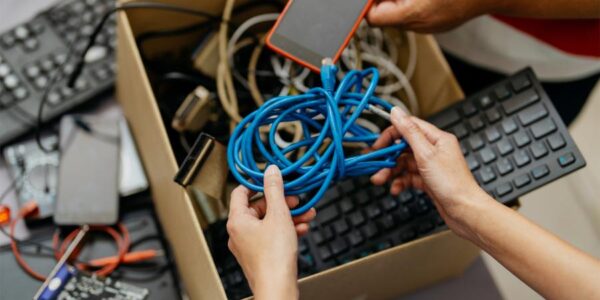

The universal waste rules California businesses follow cover old electronics, batteries, lamps and similar items. You may never put them in the trash. You can store universal waste for up to one year, label it with set wording, train the staff who handle it and keep shipment records for three years. The rules sit in Title 22, chapter 23.
This page gives each rule, its section number and what to do about it. It is general information, not legal advice. The regulations change from time to time, so confirm anything important with the Department of Toxic Substances Control (DTSC) or your local environmental health office.
What counts as universal waste in California?
California has eight universal waste categories (22 CCR 66273.1):
- Batteries, of every type
- Electronic devices, such as computers, monitors, phones and printers
- Mercury-containing equipment
- Lamps, such as fluorescent tubes and bulbs
- Cathode ray tubes (CRTs), the picture tubes in older TVs and monitors
- CRT glass
- Aerosol cans
- Photovoltaic (PV) modules, also called solar panels
In this chapter, an electronic device means one that is hazardous waste because of its toxic content. By contrast, devices that are not hazardous waste fall outside these rules (22 CCR 66273.3). Major appliances and devices recycled as scrap metal are excluded from the definition (22 CCR 66273.9).
In practice, you can't test each monitor, so most businesses treat all their retired electronics as universal waste. The universal waste rules in California are one part of the wider set of California e-waste laws, which also include the state recycling fee.
Which rules apply to your business?
The universal waste rules in California use one main label for businesses, the universal waste handler. Your duties, then, depend on what you do with the waste. Some older fact sheets split handlers into small and large quantity groups, so check the date on anything you read.
| You are | Key duties | Source |
|---|---|---|
| A household | Exempt, as long as you don't dispose of it and send it to a handler, transporter, destination facility or curbside program | 66273.8 |
| A very small quantity universal waste generator | Exempt from handler duties on the same condition as a household | 66273.8, 66273.9 |
| A business that generates its own e-waste | Handler duties: no disposal, one-year limit, labels, training and shipment records. No DTSC notification. Annual report only if you generate 5,000 kg or more in a calendar year | 66273.31 to 66273.39 |
| A business that accepts e-waste from other sites, such as a collection event host | All of the above, plus notify DTSC 30 days before you start. Annual report if you accept over 100 kg in a calendar year | 66273.32 |
| A transporter | Moves universal waste between sites | 66273.9 |
| A destination facility | The facility at the end of the line that manages the waste, such as a recycler | 66273.9 |
A very small quantity universal waste generator produces no more than 100 kg of RCRA hazardous waste and no more than 1 kg of acutely hazardous waste a month. That count covers all your hazardous waste, not just e-waste. So don't assume you qualify. Check with DTSC or the County of San Diego Department of Environmental Health at (858) 505-6700.
A business accumulating 5,000 kg or more of non-RCRA universal waste also needs an ID number (22 CCR 66273.32).
Universal waste storage time limit in California
You can keep universal waste for no longer than one year from the date it was generated, or from the date you received it from another handler. You must also be able to show how long you've had it (22 CCR 66273.35). The rule allows six ways to do that:
- Mark the container with the earliest date any item in it became waste.
- Mark or label each item with the date it became waste.
- Keep an inventory that gives each item its own date.
- Keep an inventory for a group of items, using the earliest date.
- Store items in a marked area and show the earliest date for that area.
- Use any other method that clearly shows how long the waste has been held.
For most offices, though, the first is the simplest choice. Write the date on the box or bin the day the first device goes in. Then book a pickup well before the year is up.
Universal waste labeling requirements in California
Each item must be labelled, or held in a labelled container or on a labelled pallet (22 CCR 66273.34). The label wording is set by the rule, including the double hyphen.
| Category | Label wording |
|---|---|
| Electronic devices | Universal Waste--Electronic Device(s) |
| Batteries | Universal Waste--Battery(ies) |
| Lamps | Universal Waste--Lamp(s) |
| Cathode ray tubes | Universal Waste--CRT(s) |
| CRT glass | Universal Waste--CRT glass |
| Mercury-containing equipment | Universal Waste--Mercury-Containing Equipment |
| PV modules | Universal Waste--PV module(s) |
However, the date is not part of the label rule itself. It is one way to meet the one-year rule above. That's why many businesses put both on the same sticker.
Universal waste training requirements in California
Anyone who manages or supervises universal waste needs training when they start and every year after (22 CCR 66273.36). The training covers:
- The types of universal waste on site and their hazards
- Where the waste must go, and why it can't go in the trash
- What to do if something breaks or leaks
- The labeling and handling rules
Keep dated training records for three years after the person last handled universal waste. Staff who only generate waste and drop it in the container are excluded. This matters especially for small offices. The person who runs the e-waste corner needs training. But the colleague who drops an old keyboard in the bin does not.
Handling and breakage
First, keep devices, batteries and lamps whole. A broken CRT or lamp, or a leaking battery, is harder and riskier to manage. Store items so they can't fall or crush each other, and contain anything that breaks.
The detailed containment rules sit in the sections around 66273.33. Check them with DTSC if you store large amounts or handle broken items often. Swollen and broken batteries, most of them lithium-ion, need extra care. We don't accept them loose, so send them to the City of San Diego Miramar Recycling Center by appointment.
Universal waste records in California
Handlers may not dispose of, dilute or treat universal waste (22 CCR 66273.31). Instead, it has to leave your site for a handler or destination facility. For each shipment you send or receive, keep a record of the other party, the quantity and the date (22 CCR 66273.39). You must also keep each record for three years.
| Field | Example |
|---|---|
| Name and address of the receiver | Your recycler's company name and street address |
| Quantity of each type | 12 monitors, 30 kg of batteries, 40 lamps |
| Date the shipment left | The pickup date |
In fact, pickup receipts are the easiest way to keep this record. For business electronics recycling in San Diego, we pick up free when you have 5 or more computers, laptops, monitors, servers, printers or TVs. Every data-bearing device gets a Certificate of Destruction.
Batteries and lamps
The universal waste rules in California cover batteries and lamps in the same chapter as electronics, with their own label wording. Keep them in separate labelled containers so they don't mix with devices.
Batteries
All batteries are universal waste, and CalRecycle says none may go in the trash. Our battery recycling service takes household and business batteries at our three recycling centers. For large amounts, contact us first so a manager can approve the load. Batteries inside devices can come in with the devices.
Lamps
Fluorescent tubes and bulbs are universal waste lamps. Our fluorescent light bulb recycling is available at our Point Loma and Chula Vista recycling centers. We can't take broken bulbs, so store tubes in their boxes or a rigid container.
Can small amounts go in the dumpster?
No. The trash ban has no minimum. Even a very small quantity generator, exempt from labels and training, must not dispose of universal waste. One old phone or a handful of batteries still needs to go to a recycler. For the household side of this question, see is it illegal to throw away electronics in California.
We don't cover penalties on this page, because we only publish figures we've confirmed with official sources. CalRecycle's position is that disposing of hazardous waste in the garbage is illegal.
Turn the rules into a plan
The universal waste rules in California are easier to follow as a routine. Pick one storage spot, label the containers, date the first item, train the person in charge and file every pickup receipt. Our compliance checklist sets that out as steps for San Diego businesses.
Frequently asked questions
How long can you keep universal waste in California?
Up to one year from the date it became waste, or from the date you received it from another handler. You must also be able to prove how long you've held it, for example by dating the container when the first item goes in. Book your pickup early so the year doesn't run out while you wait.
Do we need to notify DTSC to store our own old computers?
Not for storing your own. The 30-day notification is for businesses that accept electronic devices, CRTs or CRT glass from other sites. A business that only generates its own waste files an annual report only if it generates 5,000 kg or more in a calendar year. Confirm your own reading with DTSC, since these rules have changed over the years.
Who needs universal waste training?
Anyone who manages or supervises universal waste, such as the person who runs your e-waste storage area. They need training when they start and every year after, with dated records kept for three years. Staff who only drop an item in the labelled container don't need the training.
Do aerosol cans count as universal waste?
Yes. Aerosol cans are one of California's eight universal waste categories, with their own rules in the Health and Safety Code. Ask DTSC or your hazardous waste hauler how they should be stored and labelled before you collect them.
Does a very small business still need labels?
Possibly not. A very small quantity universal waste generator is exempt from handler duties, including labels, if it never disposes of the waste and sends it to a handler, transporter or destination facility. Labelling is still good practice, because it keeps waste out of the trash. Ask DTSC if you qualify before you drop the labels.